
Ground Penetrating Radar operates similarly to a sonar. A tiny pulse of energy is emitted into the ground, recording the strength and time it takes for the signal to return from the reflected object. This signal is exhibited on a visual screen and allows for the accurate detection of buried underground objects; regardless of their composition. Limitations of this method include, but are not limited to landscaping, heavy underground debris and limited accessibilities to areas.
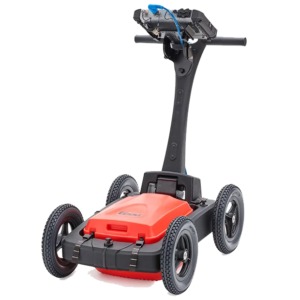
GPR works by sending a tiny pulse of energy into the ground and recording the strength and the time required for the return of any reflected signal. A series of pulses over a single area make up what is called a scan. Reflections are produced whenever the energy pulse enters into the ground with different electrical conduction properties or dielectric permittivity from the material it left. Each material has a different dielectric property.
Radar energy is not emitted from the antenna in a straight line. It is emitted in a cone shape (picture on left). The two-way travel time for energy at the leading edge of the cone is longer than for energy directly beneath the antenna. This is because that leading edge of the cone represents the hypotenuse of a right triangle.
 Since it takes longer for that energy to be received, it is recorded farther down in the profile. As the antenna is moved over a target, the distance between the two decreases until the antenna is over the target and increases as the antenna is moved away. It is for this reason that a single target will appear in the data as a hyperbola, or inverted “U.” The target is actually at the peak amplitude of the positive wavelet.
Like any other locating method, its accuracy is based on site conditions and is subject to limitations.